FOREST FLASH
November 2025
In Pacific Forest Trust’s e-newsletter, Forest Flash, we send you the most recent PFT news and updates on forests, clean water, climate, and wildlife. Subscribe here.
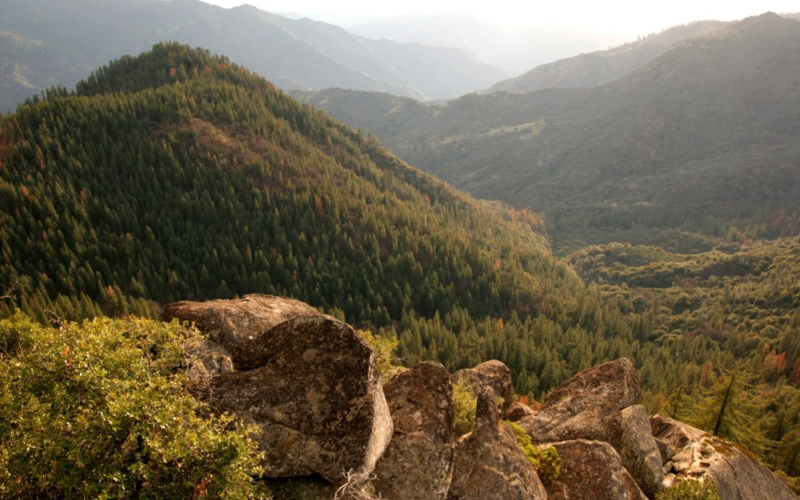
Overlooking Yosemite Valley and the Wild and Scenic Merced River, Henness Ridge is a landscape of rare beauty and deep cultural significance. In December, the Pacific Forest Trust will complete the transfer of this nearly 900-acre forest to the Southern Sierra Miwuk Nation, thus returning a piece of the Tribe’s ancestral Yosemite homeland to their stewardship.
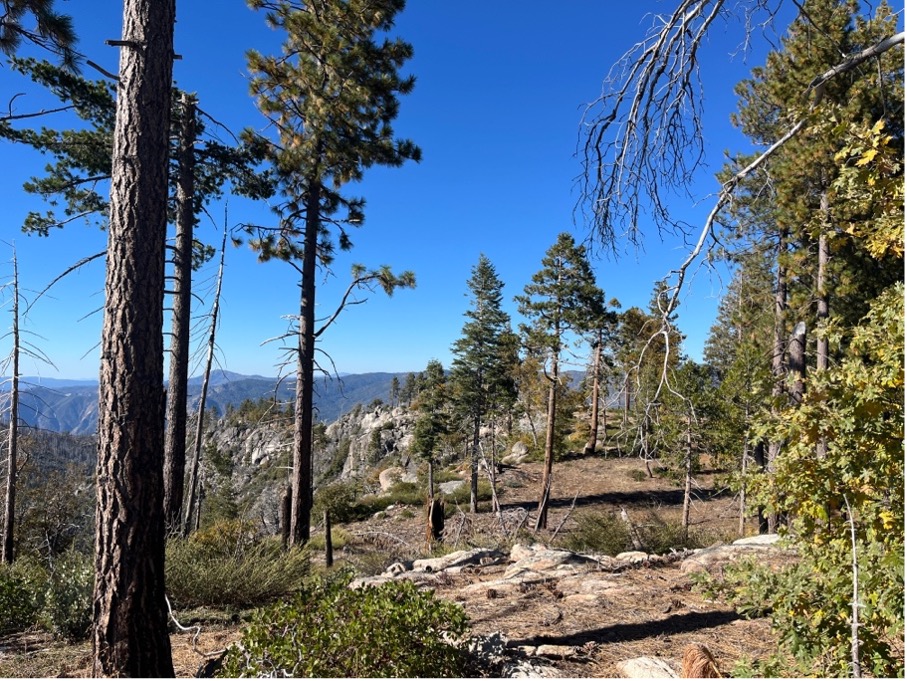
On a clear day on the ridge, you can see all the way to the Pacific.
Funded through a grant from the California Natural Resources Agency’s Tribal Nature-Based Solutions Program, the transfer marks a milestone for both cultural restoration and conservation. For the Southern Sierra Miwuk Nation, who were displaced with European settlement and the establishment of Yosemite National Park, it restores a foothold in their homeland and creates space for self-governance, cultural renewal, and community healing.
PFT acquired Henness Ridge to protect it from development, and to restore and conserve its rich mix of conifer forests, oak woodlands, meadows, and springs that feed the Wild and Scenic Merced River. The land has a long history of Indigenous use, including a traditional trail connecting the Central Valley to Yosemite Valley, following wildlife migration from lower elevation winter lands to higher elevation summer territory.
“When we were first approached about Henness Ridge, we knew its protection was integral to Yosemite’s ecology and history,” said Laurie Wayburn, PFT President.
After initial efforts to add the property to Yosemite National Park (this area was included in the original proposal for the park) were blocked in Congress, PFT began exploring another, even more fitting future—returning the land to the Southern Sierra Miwuk Nation.

Chairwoman Sandra Chapman.
“This land will be a sanctuary for our people,” said Sandra Chapman, Tribal Council Chairwoman. “It allows us to restore cultural practices, bring our community together, and ensure a healthy legacy for future generations.”
With this historic transfer, PFT and the Southern Sierra Miwuk Nation are reaffirming a shared vision: protecting the ecological integrity of Yosemite’s forests while restoring the deep cultural relationships that have sustained both people and land for millennia.
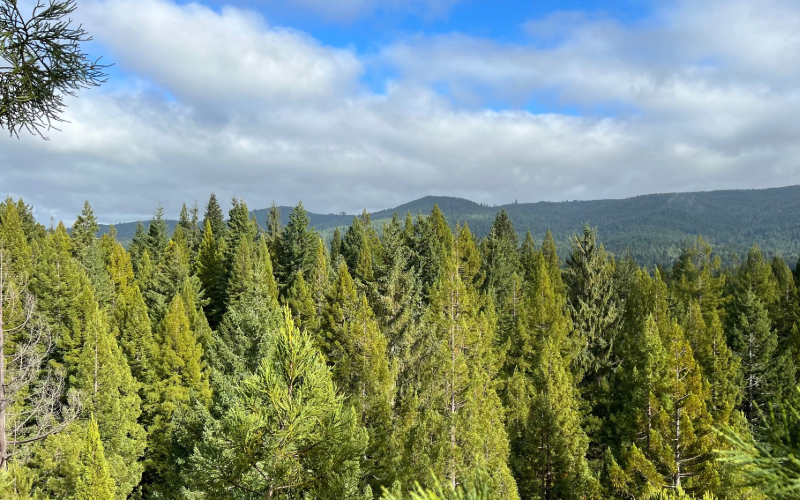
The conifer forests of the Pacific Northwest of California, Oregon, and Washington have the capacity to store more carbon than any other forest region, globally. They are also home to extraordinary biodiversity. as well as many human communities. But today, current timber management has led to these forests being very young, simple and with low carbon stocks. Managing these forests to older, more natural conditions is one of the most effective actions that we can take to mitigate and adapt to climate change. But resources and strategies to do this are limited.
To address this gap, the Volgenau Climate Initiative (VCI), is funding a regional coordinator, housed at PFT, to help bring together researchers, practitioners, agencies, landowners, and other stakeholders to promote effective ways to restore, manage, and maintain these old and mature forests. The coordinator will serve as a hub for collaboration, communications, convening, facilitating partnerships, and supporting innovative approaches to promoting older forests across three very different states and federal contexts.
This effort is not about a single project or location; it’s about creating the conditions for action across the region, and create links with other, similar initiatives to work with nature to address the climate and biodiversity crises, also sustaining human communities. Connecting diverse perspectives and fostering collaboration will help ensure restoration efforts are strategic, impactful, and sustained. PFT is proud to collaborate with VCI to help catalyze and scale work that restores old and mature forests, enhancing carbon storage, watershed health, habitat connectivity, and sustaining forest-dependent communities.
Learn more and apply today to help shape the future of our forests!
Please consider a donation to the Pacific Forest Trust. Your help—in all capacities—makes our work possible. Thanks for supporting us as we support forests!
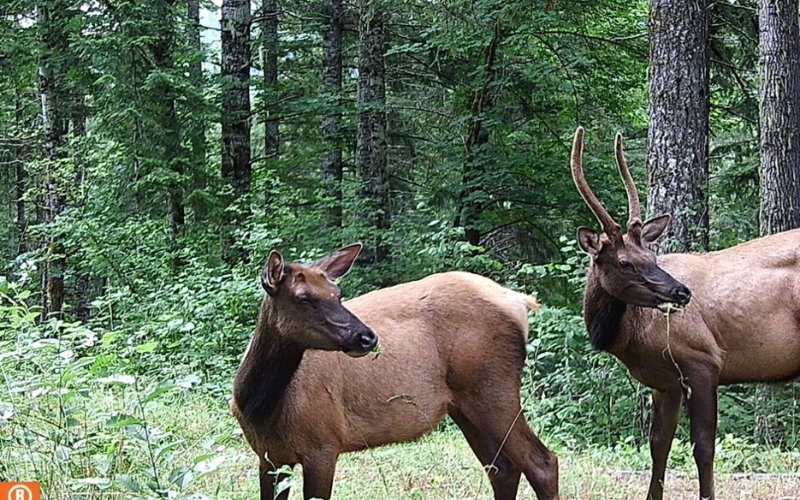
Over almost 25 years, the 7,200-acre van Eck Oregon Forest, located in Lincoln County, Oregon, has transformed from young, homogenous plantations into a thriving, ecologically diverse forest. This evolution is not only evident in the trees but in the remarkable fish and wildlife that call the forest home. Recent observations by PFT’s Forestry Technician Ursula Harwood reveal fish and wildlife of all ages—from baby bears and elk calves to big bull elk and spawning salmon—completing full life cycles in a landscape recovering from past industrial management practices.
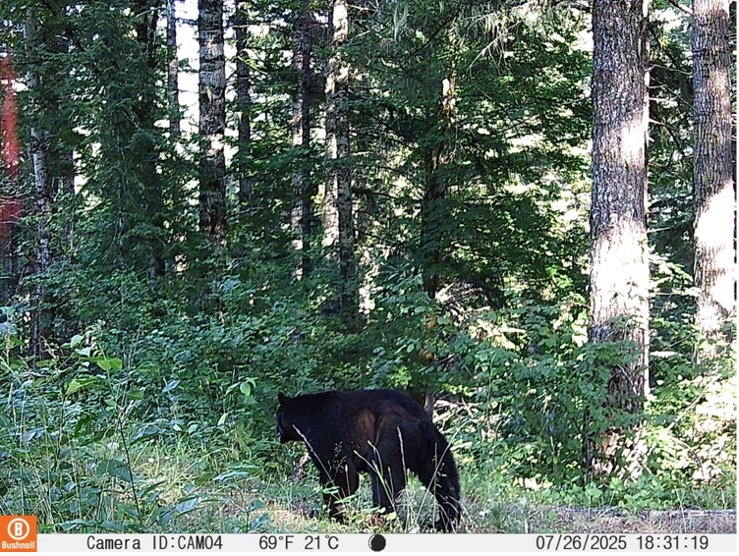
Black bear
These sightings tell a broader ecological story: van Eck Oregon supports intact food webs, with both predators and prey thriving. Salmon, in particular, play a keystone role, and PFT has restored hundreds of culverts, reshaped roads and enhanced tens of stream miles of canopy cover as well as stream habitats for salmon across the property. Salmon’s seasonal migrations carry marine-derived nutrients deep into inland forests, enriching soils and supporting countless other species. Active restoration, such as the placement of large wood in streams, enhances these habitats, providing shelter and foraging opportunities for salmon and other aquatic life. These actions improve fish habitat and help sustain healthy populations in this increasingly diverse and rich forest.
The video below captures recent salmon activity in Big Elk Creek, about 30–35 miles from the coast. Based on color, time of year, and distinctive “skunk stripes” (white marks where their skin is decaying), these are likely Chinook salmon but possibly Coho, and near the end of their lives. These salmon have made the long journey—often hundreds of miles– to spawn, and when they die, their bodies will return critical marine nutrients to the forest. The two fish in the video are possibly males, defending space or a female, among the eight fish observed in that spot.
Many terrestrial species need more complex habitat than what plantations provide, They benefit from our variable density harvests which create gaps that mimic more natural forest conditions they need. These areas provide abundant food for many species including black bears, mountain lions, elk, and Pacific giant salamanders—and help maintain a balanced ecosystem.
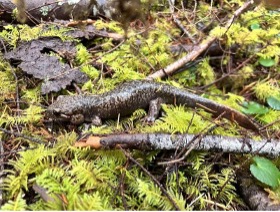
Pacific giant salamander.
Witnessing fish and wildlife thriving amidst restoration is both gratifying and hopeful. The return of birds, amphibians, mammals, and fish demonstrates that careful, science-based ecological stewardship integrates productive forestry with restoring and maintaining vibrant ecosystems. From supporting complex food webs to facilitating natural nutrient cycles, van Eck Oregon demonstrates the potential for private forests to deliver lasting ecological and economic returns.
ICYMI
In case you missed it (ICYMI), here are some other exciting things PFT has been involved in lately!
- Pacific Forest Trust is hiring! Come join our growing team for the chance to work with other friendly forest-lovers. Current open positions include Gifts Officer, Stewardship Associate, and Project Coordinator & Convener.
- Our efforts on the shaping and endorsement of the Forest Legacy Management Flexibility Act are cited in this International Fire & Safety Journal article.
- Your support has powered Pacific Forest Trust’s work this year, from restoring good fire and advancing landmark conservation projects to pioneering climate policies that protect millions of acres. With a generous anonymous donor matching all gifts up to $150,000, your early year-end contribution will double its impact for forests, climate, and communities. Donate today!