FOREST FLASH
August 2025
In Pacific Forest Trust’s e-newsletter, Forest Flash, we send you the most recent PFT news and updates on forests, clean water, climate, and wildlife. Subscribe here.
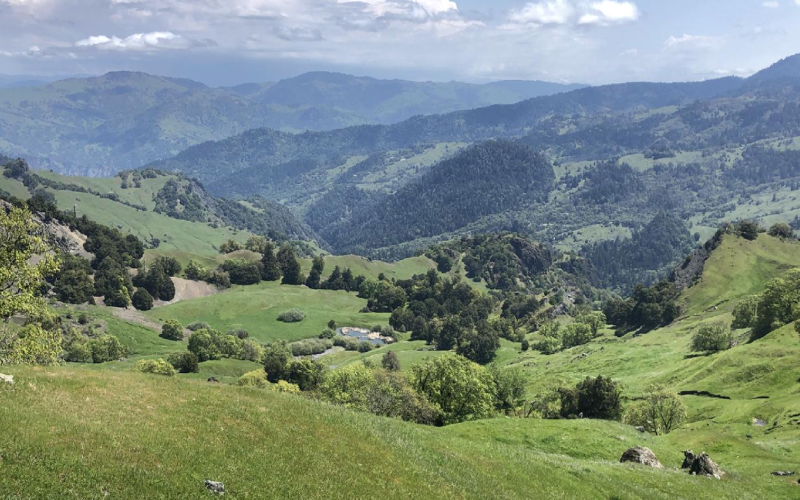
Pacific Forest Trust is working to permanently protect an ecologically significant property in California’s North Coast Range: Adanac Ranch.
Spanning more than 13,000 acres in Mendocino County, Adanac Ranch is a linchpin for biodiversity and climate resilience. This spectacular working landscape borders the Wild and Scenic Eel River and bridges a key wildlife corridor, from the Sinkyone Wilderness on the coast to Island Mountain in the interior. Its rich mosaic of grasslands, oak woodlands, old-growth Douglas-fir, and over 50 miles of streams—including direct frontage on the Eel River—is home to threatened coho and Chinook salmon, along with steelhead trout, foothill yellow-legged frogs, black-tailed deer, and golden eagles. The lands are also a very rare place where both the Roosevelt and Tule elk have been seen and are sharing habitat.
 The Adanac Ranch has been painstakingly sewn back together from many parcels to create contiguous habitat. Its conservation will ensure that subdivision and fragmentation—which would greatly impair its habitat connectivity and watershed functions—will never happen. By securing a conservation easement in partnership with the Bewley family, PFT aims to safeguard the ranch’s extraordinary natural values while supporting continued sustainable forestry and grazing operations. The project will also create an extraordinary benefit for public recreational access as it borders the managed by the California State Coastal Conservancy route of the Great Redwood Trail, a 300-mile “Rails-to-Trails” project. Conserving Adanac will ensure that hikers and bicyclists will be able to enjoy the stunning views and natural wonders of the Eel watershed forever.
Once completed, the easement will ensure that Adanac Ranch will remain a working landscape, which also serves as a refuge for wildlife, a source of clean water and climate solutions.
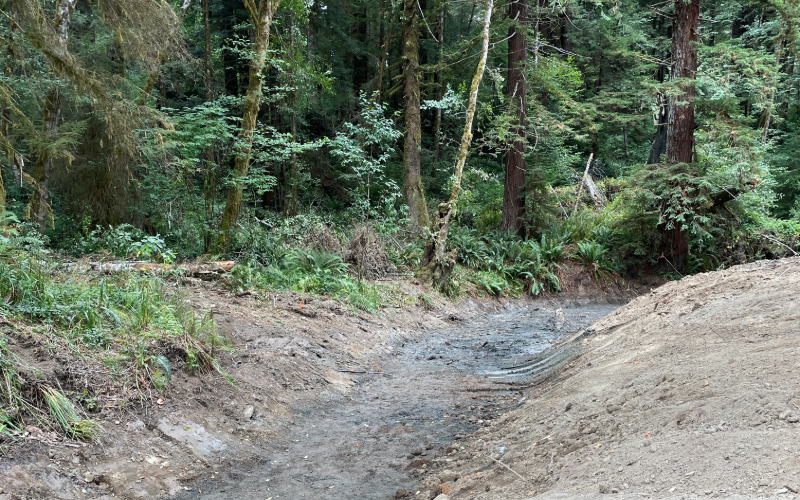
This summer, on van Eck California, PFT has been restoring an essential oxbow (an off-channel habitat feature important to fish) on Lindsay Creek—one of the most important salmon tributaries to California’s Mad River, supporting the recovery of the threatened coho salmon who live in Lindsay Creek.
Coho are amongst the most endangered fish in California, and the Mad River is key to their survival. Historic logging, agriculture, and railroad development reshaped Lindsay Creek, cutting off its side channels and simplifying habitat that once sheltered young salmon during winter floods. Now, this project is helping reverse that legacy by restoring complexity and flow to a critical off-channel area.
The project is carried out with funding from the California Department of Fish and Wildlife (CDFW) and working with our long-time partners at Pacific Coast Fish, Wildlife, and Wetlands Restoration Association. The project entailed excavating historic fill placed there during the era when a railroad was placed along the creek, installing very large and long arched culvert to reconnect the 800-foot oxbow that was historically on Lindsay Creek and allow free flow of water, especially during winter storms. Part of the project entailed felling 60 larger spruce trees and placing them in the creek to add structure and create winter refugia for juvenile salmonids.

L-R: Arley, Jared, and Brody, who are all working on this restoration project.
Years in the making, the project is a major and gain for fish. It is part of a larger cooperative push to restore salmon habitat across California’s North Coast. By restoring side channels and reconnecting floodplains, partners across the region are stacking synergistic benefits that increase the odds of long-term recovery. We are proud to contribute a piece of that larger puzzle, helping ensure salmon have the habitat they need to thrive and future generations can enjoy seeing the miracle of salmon spawning, growth and migrations.
Please consider a donation to the Pacific Forest Trust. Your help—in all capacities—makes our work possible. Thanks for supporting us as we support forests!
Momentum is building for one of the most innovative tools that could be deployed in California’s climate policy: Nature-Based Climate Credits (NBCCs). In just a couple of weeks, the state’s landmark climate policy with its Cap and Invest program is being proposed for renewal and the NBCCs proposed for that would become an alternative way to meet a portions of covered entities obligations. This would be a powerful, mulit-impact, and affordable new way to meet the state’s climate goals.
NBCCs would expand cost-effective compliance options under California’s cap-and-trade program while delivering benefits far beyond carbon reductions alone. Unlike traditional offsets—nearly half of which occur outside the state—NBCCs would be grounded in California conservation and restoration projects that are permanent, additional, verifiable, and quantifiable. This ensures real and lasting results that Californians and companies alike can see and trust. And, these projects would deliver significant benefits for adaptation, biodiversity protection and watershed function, helping ensure the state’s water supply
Here’s how it works for a forest-based project: A landowner agrees to place a Working Forest Conservation Easement on their property. This permanently conserves the forest and directs it’s management to enhance both carbon stores and overall resilience, maintaining productive use. In return, the state gains measurable carbon reductions, improved wildfire resilience, protected water supplies, preserved habitat, and secure rural jobs, all at just $10–15 per ton—far more affordable than reductions in other sectors.
The potential is staggering. Conserving even a fraction of California’s 12+ million acres of privately owned conifer forests could yield 150–300 million tons of carbon storage in the next decade alone, while providing hundreds of millions of dollars annually for reinvestment in climate action.
As climate impacts mount, NBCCs offer a reliable, low-cost, California-based solution that strengthens the cap-and-invest system while amplifying benefits for communities, water, and wildlife.
With the legislative deadline approaching, now is the time for lawmakers to act. Nature-Based Climate Credits are an immediately available way to make California’s climate program stronger more affordable and more effective, setting a new state model for how natural and working lands can deliver climate resilience at scale. We urge you to contact your California state senators and assembly members to show your support for this groundbreaking tool!
ICYMI
In case you missed it (ICYMI), here are some other exciting things PFT has been involved in lately!
- PFT President Laurie Wayburn pens a Capitol Weekly op-ed urging lawmakers to adopt Nature-Based Climate Credits as a cost-effective, California-focused solution in the cap-and-trade reauthorization debate.
- A coalition of 130+ conservation, health, and equity groups is urging California lawmakers to immediately release Proposition 4 funds in the FY 2025–26 budget to deliver on voter mandates for clean water, wildfire prevention, biodiversity, and equitable climate resilience. Read the sign-on letter here.